Monday, February 21, 2011
CAC Dusts Off Street Art Swag
Thursday, January 6, 2011
If the CAC Doesn't Want to Listen to Me, Perhaps They'll Listen to ArtNews
"But arts professionals need to be proactive now if they want to forestall a new culture war. Anti-censorship statements on websites are fine—the AAMD released one condemning "unwarranted and uninformed censorship from politicians and other public figures"—but does the general public read such statements? So far, the opponents of "Hide/Seek" are getting most of the media attention. While bloggers and newspaper cultural critics have kept the story alive online, why aren't museum directors showing up on op-ed pages and talk-show stages? After all, Ellen DeGeneres herself is a protagonist in the controversy. If museum advocates want to change the public conversation, they have to become part of it." (my emphasis)
Monday, December 20, 2010
But 20 Years Ago, Cincinnati Invested in Art's Dialog
Debates like this make even our friends and supporters leery of publicly backing the arts -- whether with money or advocacy."
Tuesday, December 7, 2010
Where is the CAC?

Since the pulling of the David Wojnarowicz video, A Fire in My Belly, from the Smithsonian last week, art critics are not the only ones angry about their cowering to the demands of the Catholic League and John Boehner. Museums and galleries are now joining the protests. You can find the best coverage of this story on Tyler Green's blog at Artinfo.
"First of all, it needs to be said that we strongly stand behind the statement made through the AAMD. It is in direct alignment with our unique institutional (obviously) perspective on issues of censorship and political pressure on the arts. Specifically, I’d like to underscore the section that reads:
'freedom of expression is essential to the health and welfare of our communities and our nation. In this case, that takes the form of the rights and opportunities of art museums to present works of art that express different points of view. Discouraging the exchange of ideas undermines the principles of freedom of expression, plurality and tolerance on which our nation was founded. This includes the forcible withdrawal of a work of art from within an exhibition—and the threatening of an institution’s funding sources.'
It is alarming to be confronted with another example of the arts’ vulnerability to this kind of attack. Just as we saw 20 years ago, this public debate can shed light on that. And if there is something that history has shown, it’s that public support can change the dynamic. It’s possible, we’ve seen it happen.
The arts play an invaluable role in creating community and public dialogue and—in the end—the more we can show that, the more successful we will be at neutralizing this kind of attack in the long run."
Wednesday, December 1, 2010
What Does the NPG Really Learn from the CAC?
Sunday, September 19, 2010
The CAC Has Learned Nothing and Goes Nowhere New
"The show is not a one-liner or super-straightforward statement - that's part of the beauty of it," says Platow. Art is not arranged chronologically or geographically, though there are themes: art about art, text in art, art and urban anthropology."
"We play with the fact that this is a private collection by a person with varied interests," Platow says. "We present an experience that proposes the moment before institutional framework is installed. Dichotomy doesn't exist in the installation or collection."
...Platow says, but "the collection is about transcendence."
Sunday, August 1, 2010
ArtWord: Kristine Donnelly
.jpg)
This month, the Taft Museum of Art will open its second Keystone Contemporary exhibit. This annual series highlights the work of an emerging artist in the Tristate region with a small scale solo show. This year, the museum is featuring the work of Kristine Donnelly. While preparing for this solo show and working at the Cincinnati Art Museum as the Coordinator of Family Learning, Ms. Donnelly took the time to meet with me and answer some questions about her work.
1. Like many successful artists, you began as a figural painter. Can you tell me a bit more about your earlier work? What specifically does painting not allow you to do that your current medium does? And perhaps just as interesting, what challenge does cut paper provide (for you and your viewer) that painting may not?
.jpg)
In my current work, the patterns I create are composites from a variety of sources: images of skin, biological cells, lace patterns, and architectural elements. Creating the pattern is painstaking and deliberate. My intent and thought process behind the patterns is abstracted and obstructed from the viewer. It isn’t necessary that that the viewer have full insight into the origin of the forms. Viewers will see structures both fragile and strong that can’t easily be defined. They’ll find connections to biology, craft and textiles. The cuttings also invite the viewer to question and redefine positive and negative space. Viewers can look at the pieces and through the pieces. Wall, floor, light and shadow become players in the pieces and bring new definitions.
As I said earlier, I hope that the universal material brings understanding and approachability to my work. The labor and delicacy is meant to confront and engage. Certainly my work could be made in a fraction of the time by using technology. It would be perfect and flawless. However my work is by choice laborious. The images are hand screenprinted.

I had the opportunity to work on the installation crew for the Contemporary Arts Center’s Tara Donovan in 2009. It was very surreal to no only meet this artist, but to assist in creating her pieces for an exhibition. At the time, Donovan’s work challenged every definition I had for what art should be: permanent, archival, recognizable, narrative, etc. I loved how she made art from everyday objects. I loved how her work was both feminine and masculine. How it evoked aesthetic responses in both artists and non-artists. I felt that her work was in dialog with French landscape paintings, but in 21st century terms. How pencils and buttons became topographical maps and plastic straws looked like wrinkles of skin.
It was exciting to work with Tara and her crew and learn about the creation process and discuss the site-specific nature of her work. The pieces changed shape and stature within the different exhibition spaces. The unique architecture of the CAC played a prominent role in the shaping of Donovan’s work. It was interesting to hear how her work was developing and changing from new materials to processes.
5. While you both may use similarly recognizable materials, Donovan’s work seems to rest more on the unit that is repeated. We easily recognize the Styrofoam cup or plastic straw, for instance. Your work though requires one to look closer in order to identify the unit; to note repetition or pattern. Explain how pattern and repetition in interior decorated spaces is the focus of your work, yet not necessarily immediately apparent to the viewer. Do you run the risk of the viewer simply loving the look and texture of your pieces as interior decoration only?
The screenprinted patterns in my work are taken from organic (cellular) and architectural forms as well as established patterns and motifs from historical wallpaper and lace. I combine different sources to create a composite image that becomes a pattern by repeating it via screenprint. I take long rolls of paper and repeatedly screen print the motif. The repetition is lessened when I begin cutting into the paper rolls. The patterns are compromised with new openings and negative shapes. When the cut paper rolls are combined to create a larger form they are often twisted, layered, rolled, and piled. Thus the patterns are further abstracted and obstructed. The screen printed patterns and the cut paper openings then become the vehicles for design. They play off the existing architecture, both exposing and covering it. They create a new definition for the work. The viewer is invited to investigate the detail and texture of the piece as well as the space it resides in.
Certainly my work has a dialog with decoration. I’m interested in wallpaper- how it can recede subtly in the background or loudly overtake a space. It is a cheap impermanent way to assign a space an “identity.” I’m also interested in draperies- how beautiful forms are created to serve as a covering. Delicate curtains are intended to conceal things and bring privacy. My work explores the function and forms of decorative elements.
When invited to make work for the 2010 Keystone Contemporary Exhibition at the Taft Museum, I was immediately excited about exploring the Taft’s interior decoration. The draperies, walls, and floors, were central to creating work for the exhibition. I relied on the Taft’s interior architecture, patterned designs, and color palette.

Monday, May 10, 2010
CAC Recycling Program
Monday, March 15, 2010
Fashion Designer John Bartlett at the CAC
On Monday, April 26th at the CAC John Bartlett will talk about the relationship between fashion and art and his experience using creativity as a tool in his life. He will discuss his roots and inspiration in Cincinnati, and the vision he is pursuing with his flagship store in Manhattan's West Village as a "breeding ground of creativity and a collaboration of diverse local artisans."
Wednesday, February 10, 2010
Where is ArtWorks?
Sunday, January 17, 2010
"Shepard Fairey: Vandal or Artist?" You've Got the Wrong Guy
Monday, November 30, 2009
Still No Mention of Cindy Sherman
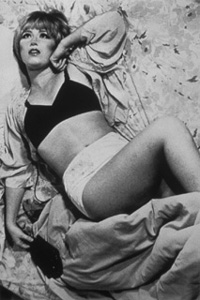
Though here is yet another review of Marilyn Minter's work that doesn't mention Cindy Sherman. A photographer like Minter, Sherman has focused on female types in the media. While Sherman shoots pictures of herself, she is not the subject of her photographs. She instead presents herself in costume depicting various women: the disheveled or frightened woman, the woman waiting for the phone to ring, even the pin-up. With these photographs, Sherman questions the roles of women presented in the media. Later, her work with mannequins includes disturbing representations. These seem to point more accusingly to the manipulation of women's bodies in fashion magazines, boutiques, and runways. These are not pretty pictures.
Because both Minter and Sherman share similar media and subject matter, I'm still surprised that no review has yet mentioned Sherman. Could it be that Cindy Sherman('s work) is not pretty enough?
Thursday, November 12, 2009
Maxxi: The CAC's Organic Sibling
While the review makes note of Hadid's dynamic style by comparing Maxxi to her design of the BMW factory just outside of Leipzig, Germany, the images of the Maxxi strongly recall our own Contemporary Art Center, also designed by Hadid. Admittedly the exterior looks almost nothing like the museum in Cincinnati, but Maxxi's dominating stairway and the dramatic interior spaces easily reference the CAC. In fact, Hadid's new structure looks like a mirror image of the CAC; a fun house mirror. Hadid's analytical lines and strong grid that stabilizes the CAC become much more organic and sensuous in Rome.
You can see the slide show of Maxxi here.
Thursday, November 5, 2009
Cincinnati's Sara Vance Appointed to Ohio Arts Council Board
Governor Ted Strickland has announced the appointments of Jacquelyn Nance of Moreland Hills, Sara Vance of Cincinnati and the reappointment of Barbara Gould of Cincinnati to the Ohio Arts Council Board. Ms. Nance and Ms. Vance will serve terms ending July 1, 2014, replacing Neal Zimmers of Dublin and Ginger Warner of Cincinnati, whose terms expired. Ms. Gould was reappointed for a term ending July 1, 2014.
“We are delighted to have appointees who possess long-held commitments and connections to both their community and the arts,” said Julie Henahan, Executive Director of the Ohio Arts Council. “Each appointee’s experience and background will be a great asset to our board.”
Jacquelyn Nance is an attorney and native of Northeast Ohio and currently serves as the president of Philanthropic Solutions. She previously served as executive director of the LeBron James Family Foundation, president of the Cleveland Browns Foundation and the senior planned giving attorney with the Cleveland Clinic Foundation. Nance serves on the board of the Rock & Roll Hall of Fame and Museum, the Charter One Bank & Fox 8 News’ “Champions in Action” Selection Committee and the Cleveland Clinic Heart Center National Leadership Commission. Ms. Nance studied dance for 18 years. She received a bachelor’s degree from Spelman College and a law degree from Case Western Reserve University.
Sara Vance is the owner/president of SMV Media, a media management company she founded in 1994. She previously served as a media director and vice-president of local advertising agencies in Cincinnati. Ms. Vance attended Morehead State University, where she earned her bachelor’s degree in Journalism, with an emphasis in public relations/advertising. Ms. Vance serves on the Board of Directors of the Cincinnati Art Museum as chair of Artworks and as president of Cancer Family Care. Her previous board commitments have included the Contemporary Arts Center as vice president, Enjoy the Arts, Ensemble Theater of Cincinnati, The March of Dimes and the Ronald McDonald House Charities. Ms. Vance received the House Advocate Award in 2005 from the Ronald McDonald House, the Heart for the Arts Award in 2007 from Learning Through Art and the Champions for Children Award from 4C for Children in 2009. In addition, she has gifted the top floor of the Contemporary Arts Center for children called the Sara M. & Patricia Vance Education Center.
Barbara Gould, from Cincinnati, was reappointed for a term ending July 1, 2014. She has been a an OAC board member since 2007. She served in the fashion, interior design and music industries before retiring. She serves on numerous cultural arts boards in the Cincinnati area, including the Cincinnati Opera, Ensemble Theatre of Cincinnati, the Cincinnati Arts Association, the Cincinnati Ballet, and the Arts Consortium of Cincinnati. Gould received a bachelor’s degree from the University of Michigan.
The Ohio Arts Council is a state agency that funds and supports quality arts experiences to strengthen Ohio communities culturally, educationally and economically.
Thursday, October 22, 2009
Marilyn Minter Interview on Huffington Post
Minter will open a show in Los Angeles this weekend at the Regen Projects.
Saturday, October 17, 2009
Following Fairey Back to the CAC
As Fairey celebrates with Warhol, the AP reported the artist's attorney is admitting Fairey lied about which photo he used for his "Hope" poster and deleted images to conceal his mistake.
In other news, Fairey donates works to benefit orphans in Uganda: Artdaily
As with many artists who exhibit or work in Greater Cincinnati, I encourage you to continue to follow Fairey as he returns for a second visit to the CAC in February 2010.
Friday, August 21, 2009
Tara Donovan to Exhibit at Neighboring IMA
Tara Donovan: Untitled will open at the IMA April 4, 2010 and be on view through August 1, 2010
Wednesday, July 22, 2009
CAC Recieves Three Major Grants
See the good news here.
Wednesday, April 29, 2009
Is the CAC on the wrong side of art?
I hope the CAC intends to address these issues. That Supply and Demand is scheduled to travel to the Warhol Museum in Pittsburgh before arriving in Cincinnati will not wipe clean the problems Fairey brings. Warhol celebrated the copy. Fairey is no Warhol In fact, up to this point Fairey has cloaked himself in a willingness by the public be ignorant of his “lifting” of art. Is Raphaela Platow, Director of the CAC counting on the same kind of protection? Also, if the CAC plans to present him as a “street artists,” they should know there are a number of street artists who have issued challenges to Fairey and his work….challenges he has up to this point ignored. I presented this discussion in an earlier post.
Despite the loud cries of disdain for Fairey from much of the art world, Ms. Platow insists, “He has made a successful move into museums.” Successful? Really? As the Director of the CAC, Raphaela Platow should be the city’s leading advocate for contemporary art and artists. A blind eye to Fairey’s "lifting" of art and a deaf ear to the protest by artists puts her advocacy into question.